
The internal longevity of a property is measured through concrete indicators: the condition of the coverings, the performance of technical networks, and the durability of the joinery. Comparing the actual lifespan of interior components to the maintenance cycles practiced by owners reveals significant discrepancies, often underestimated during a transaction or diagnosis.
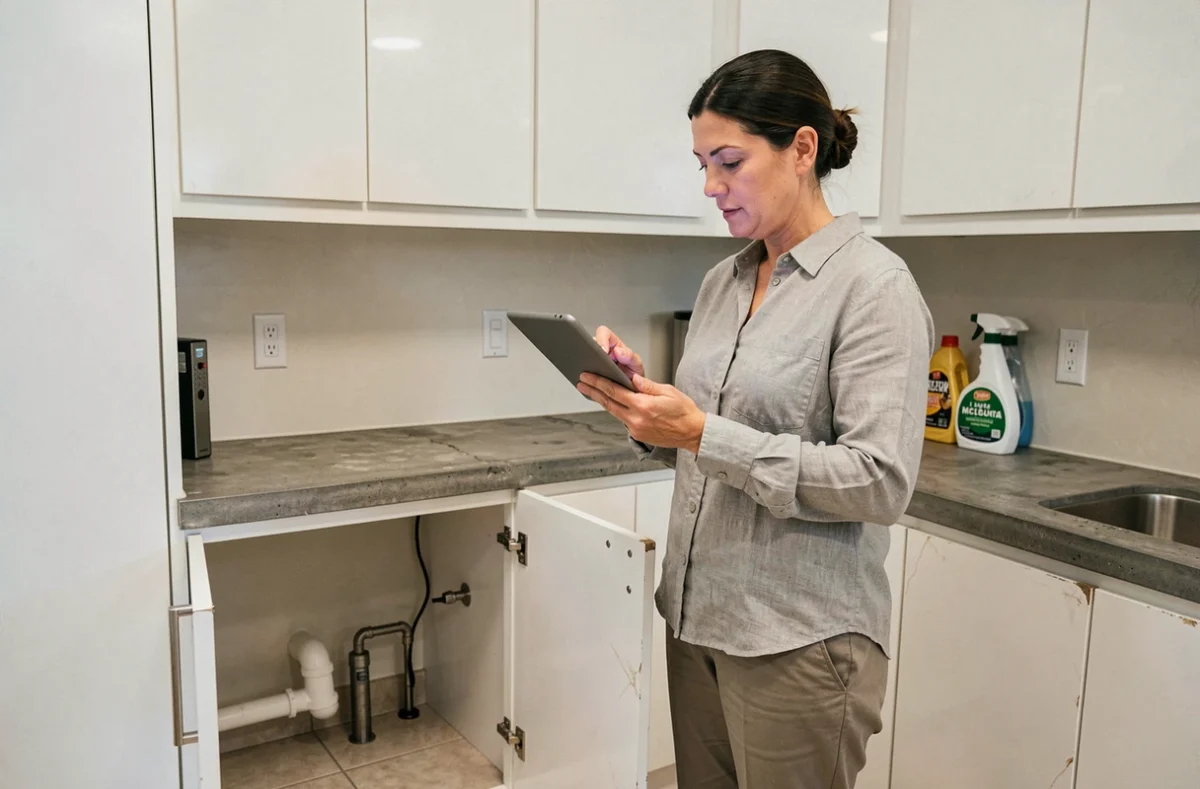
Hidden pipes and embedded networks: the invisible factor that conditions everything
Competing content focuses on visible maintenance (paints, floors, sanitary equipment) and almost systematically ignores embedded networks. Yet, this is the area where failures are the most costly, as it requires intervention on walls, floors, and sometimes ceilings.
Since the Climate and Resilience Law, the issue of sanitation and pipelines has been subject to increasing regulatory pressure in condominiums. Responsibility is shared between the property manager (common areas) and each co-owner (private areas), creating gray areas during incidents involving through columns.
To delve deeper into internal longevity according to Quartier Immo, this technical dimension must be integrated from the acquisition stage. A diagnosis of water and drainage networks, even if not mandatory for individual houses, allows for anticipating heavy work that mere observation of surfaces does not reveal.
In practice, a properly installed copper network lasts significantly longer than a galvanized steel network, which can corrode from the inside without visible signs for years. Identifying the material of the pipes during a purchase is a reflex rarely adopted, even though it directly conditions the lifespan of the interior structure.
Multi-year work plan in condominiums: internal longevity framed by law
Since the Climate and Resilience Law, any residential condominium over fifteen years old must develop a multi-year work plan (PPT) over ten years. This document covers the preservation of the building, maintenance of common areas, and improvement of energy performance.
The obligation has come into effect in successive phases:
- Since 2023 for condominiums with more than 200 lots, which were the first to be required to produce this document and allocate the corresponding funds.
- Since 2024 for those with between 51 and 200 lots, expanding the requirement to the majority of medium-sized residences.
- Since 2025 for condominiums with 50 lots or fewer, which now includes almost the entire French stock.
This timeline changes the game for owner-occupants as well as investors. The internal longevity of the property is no longer solely dependent on good individual practices: it is structured by a mandatory ten-year program, integrated into the budget forecast and voted on in the general assembly.
What the PPT changes concretely for an owner
The PPT requires estimating upcoming work and prioritizing it. An owner purchasing in a condominium with a recent PPT has visibility on foreseeable expenses, reducing the risk of unpleasant surprises.
Conversely, the absence of a PPT in a concerned condominium is a warning signal. It indicates either a governance failure of the property manager or a blockage in the assembly, both situations that accelerate the degradation of common areas and, by extension, the apartments.
Comparative lifespan of interior components: coverings, joinery, and equipment
Not all elements of an interior age at the same rate. The table below compares the average observed lifespan of several common components with the recommended frequency of maintenance or replacement.
| Interior Component | Current Lifespan | Recommended Maintenance Frequency |
|---|---|---|
| Wall paint | Five to ten years depending on exposure | Refresh every five to seven years |
| Solid wood flooring | Several decades if sanded regularly | Sanding every ten to fifteen years |
| Laminate flooring | Significantly shorter than solid wood flooring | Replacement as soon as swelling appears |
| Interior wood joinery | Long lifespan with maintenance | Annual inspection of seals and hardware |
| Faucets | Variable depending on water quality | Descaling every six months in hard water areas |
| Single-flow VMC | Limited lifespan without cleaning | Cleaning of vents and filters twice a year |
The gap between theoretical lifespan and actual lifespan almost always depends on the regularity of maintenance. A properly sanded solid wood floor lasts several times longer than laminate, but a floor that is never maintained can deteriorate just as quickly.

Areas where maintenance has the most impact
The VMC illustrates this mechanism well. An extraction system whose vents and filters are never cleaned loses flow, which promotes humidity, mold, and accelerated degradation of paints and bathroom seals. Maintaining ventilation indirectly protects all interior coverings.
Faucets are another underestimated area. In hard water areas, regular descaling of aerators and hoses extends the lifespan of the entire visible sanitary circuit. Waiting for a failure means replacing not only the faucet but sometimes also the connections damaged by accumulated limescale.
Energy performance and air quality: two levers linked to internal longevity
The energy performance of a home not only affects heating bills. A lack of insulation creates thermal bridges, leading to condensation on cold walls. This condensation accelerates the degradation of coatings, paints, and wall coverings, sometimes in just a few years.
The PPT now incorporates energy improvement into its programming, directly linking energy renovation and preservation of interior finishes. Addressing a thermal bridge protects both comfort and surfaces.
Indoor air quality operates according to the same mechanism. A poorly ventilated home accumulates moisture produced by cooking, showering, and the occupants’ breathing. Without sufficient evacuation, this moisture settles on surfaces and feeds mold, which attacks seals, plaster, and woodwork.
The internal longevity of a property relies less on the choice of finishing materials than on the management of invisible flows: water, air, heat. An owner who monitors their networks, maintains their ventilation, and anticipates structural work through the PPT protects their asset much more effectively than by repainting every five years.