
The awakening of a baby refers to the set of sensory, motor, and cognitive acquisitions that begin to develop in the first weeks of life. Neural connections multiply at an intense rate during the first year, primarily thanks to interactions with the immediate environment. Supporting this process does not require sophisticated equipment, but rather thoughtful choices regarding the quality of objects, the safety of materials, and the pace offered to the child.
Traceability of developmental toys: what the European regulation changes
Most guides on baby awakening list activities without addressing the question of the materials themselves. Toys, night lights, and developmental accessories purchased online pose a concrete traceability issue.
The European regulation on the general safety of products has been in effect since December 13, 2024. It strengthens the requirements for identifying the manufacturer or importer for products sold online, as well as risk assessment. This directly concerns parents who order from marketplaces where the origin of the items remains unclear.
Another text, Regulation (EU) 2025/2509, is set to gradually replace Directive 2009/48/EC and will apply from August 1, 2030. It provides for changes regarding the composition, traceability, and compliance of children’s toys.
For families, the impact boils down to a simple reflex: check that the packaging mentions an identifiable manufacturer and a CE marking before introducing an object into the play area. Resources like Bébé Magique help better identify products suitable for each stage of development.
Second-hand toys also deserve special attention. In French childcare facilities, recovered materials can be used as long as they do not present a clear danger and complied with the standards in effect at the time of their first market introduction.
At home, the logic is the same: a second-hand toy requires inspection, not just cleaning. Detachable parts, chipped paint, small elements that could be swallowed – each point must be inspected before entrusting the object to an infant.
Free motor skills and sensory awakening: setting the framework before offering games
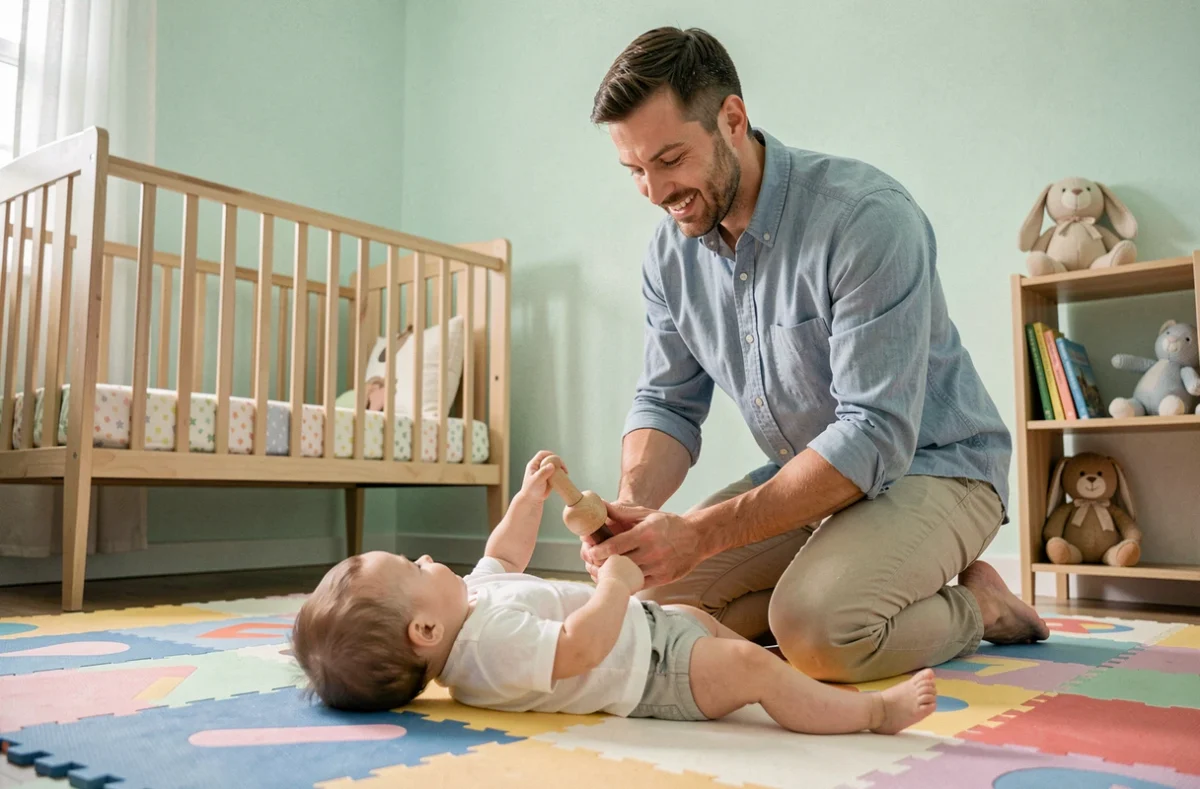
Free motor skills are based on a principle formulated by pediatrician Emmi Pikler: allowing the baby to experiment with positions and movements by themselves, without placing them in a posture they have not yet acquired independently. Practically, this means laying the infant on their back on a firm, clear surface and letting them turn over, crawl, and stand up at their own pace.
A play mat placed on the floor is sufficient for the first months. Adding arches or mobiles above the baby’s field of vision stimulates hand-eye coordination without forcing movement. Between three and six months, voluntary grasping begins to develop: objects with varied textures, placed within reach, encourage coordination and tactile exploration.
Sensorial stimulation without overstimulation
A common pitfall is to multiply stimuli at the same time. A toy that emits sounds, lights, and vibrations simultaneously does not necessarily promote learning. The infant’s brain processes one piece of information at a time more effectively.
- Vision develops gradually: strong contrasts (black and white) capture attention during the first weeks, then bright colors take over around three months.
- Hearing is already functional at birth. Talking to the baby, singing, and varying intonations provide the most effective auditory stimulation for language development.
- Touch refines through contact with different materials: smooth wood, fabric, soft rubber. Alternating textures during free play enriches sensory connections.
Offering one or two objects at a time is more beneficial than a basket full of toys. The baby explores more deeply when not overwhelmed by choices.
Child’s rhythm and daily well-being: adjust rather than plan
Awakening activities only work if they respect the baby’s attention windows. An infant under three months remains awake and receptive for short periods, often less than an hour. Offering a developmental game to a tired or hungry baby produces the opposite effect of what is intended.
The baby’s well-being also depends on the regularity of daily rituals. Bathing, changing, and mealtime are fully-fledged awakening moments. Naming body parts during changing, describing actions during bathing: each routine becomes a language and bonding activity without requiring additional materials.

Adapting games to age without rigidity
Developmental grids by age provide useful benchmarks, not obligations. An eight-month-old baby who is not yet interested in stacking toys is not delayed: they may be exploring fine manipulation or movement more.
- Before six months: mobiles, lightweight rattles, skin-to-skin contact, songs. Face-to-face interaction with the parent remains the richest source of awakening.
- From six to twelve months: objects to grasp, tap, and transfer. Object permanence begins to develop (the peek-a-boo game makes sense during this period).
- After twelve months: first nesting toys, exploring walking, imitating daily gestures. Everyday objects, such as a wooden spoon or a lidded box, rival specialized toys.
Supporting awakening relies less on the accumulation of toys than on the quality of presence and the relevance of the materials offered. A safe environment, objects compliant with current standards, and a rhythm aligned with the child’s real needs form the most solid foundation to support their development over the months.