The French 3D animation market remains one of the most structured in Europe, with a network of studios spread between Paris, Angoulême, and a few regional hubs. However, the contraction phase the sector is experiencing is changing the conditions for entry-level positions. Understanding the real recruitment mechanisms, professional statuses, and promising specializations allows one to navigate their career with clarity right after completing their training.
Production pipeline and specialization: the true recruitment criterion in 3D animation
Studios recruit for a specific position in the production chain, not for a generalist profile. A 3D animator applying as a versatile candidate sends a signal of being an undifferentiated junior. Animation directors want to see a targeted demo reel: acting for feature films, creature locomotion for VFX, procedural animation for video games.
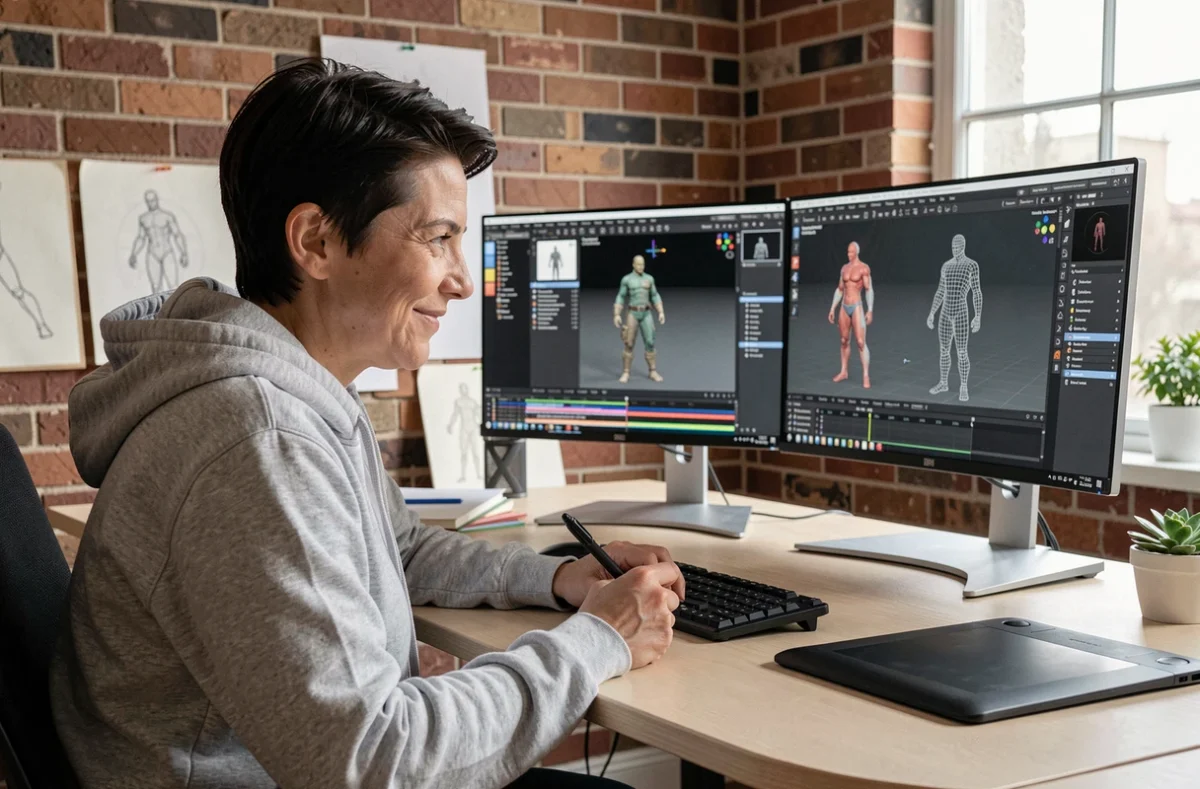
In film or series production, the pipeline clearly separates layout, blocking, splining, and polish. Each step requires distinct technical reflexes. A profile that masters blocking in strong poses with readable timing will find it easier to secure a position in a studio than a candidate whose demo reel shows a bit of modeling, a bit of rigging, and a bit of animation.
We observe that early specialization does not hinder mobility. An animator trained in Maya for feature films can switch to real-time under Unreal Engine, provided they demonstrate their understanding of framerate constraints and optimization. Conversely, the reverse transition (real-time to film) often requires a refresher on polish and animation curves.
To accurately map job opportunities on emploiparlonsnet.fr, it is useful to cross-reference job descriptions with actual offers published by French and international studios.
Intermittent status in the entertainment industry: anticipating contractual reality
Intermittency is the dominant mode of employment in feature film and series animation. Contrary to a common misconception propagated by some job descriptions, permanent contracts (CDI) remain rare in French animation studios. The majority of 3D animator positions operate under fixed-term contracts of use (CDDU), linked to appendices 8 and 10 of unemployment insurance.
In practical terms, this means accumulating a sufficient number of hours worked over a reference period to qualify for compensation rights between two assignments. 3D animation training rarely addresses this topic, even though it conditions the financial viability of the early years of a career.
- Understand the calculation of hours and the reference period even before the first contract, to avoid breaks in rights.
- Anticipate lean periods (often between two production seasons or after delivering a film) by building a safety net of savings.
- Negotiate your daily rate by factoring in the real cost of intermittency: contributions, uncovered periods, travel expenses to studios.
Profiles moving towards video games largely escape this regime. Game studios more frequently hire on permanent contracts or classic fixed-term contracts. This contractual distinction should be weighed when choosing a specialization.
Impact of AI on 3D animation jobs: what is really changing
Artificial intelligence tools are redefining certain links in the chain, but the impact varies significantly depending on the position held. Character animation still relies heavily on artistic sensitivity that generative models do not reproduce with the finesse required by a demanding art director.
On the other hand, clean-up tasks, automated in-betweening, or the generation of generic walk cycles are beginning to be accelerated by solutions integrated into the pipelines. For a 3D animator, the differentiating skill remains the ability to direct the intention of a shot: digital acting cannot be delegated to an algorithm.
The European regulation on artificial intelligence provides for transparency obligations regarding certain content generated or manipulated by AI, with a gradual implementation. Artists working in advertising or content production for social media will likely be the first affected, as these formats often mix hand-produced elements and generated assets.
AI skills to integrate into your profile
We recommend acquiring functional mastery of AI-assisted motion capture tools and automatic retargeting plugins. These are not skills that replace traditional animation but production accelerators that studios increasingly expect in intermediate profiles.

3D animator salary scale and career progression
A junior profile in 3D animation can expect a gross annual salary between 32,000 and 36,000 euros. Progressing to an intermediate position (three to five years of experience) places the range between 36,000 and 48,000 euros gross. Senior profiles, lead animators, or animation supervisors, reach salaries between 48,000 and 65,000 euros gross annually.
These figures correspond to the French market and vary by location. Parisian studios offer higher daily rates, but the cost of living reduces the actual gap with hubs like Angoulême or Lyon.
Possible evolutions beyond pure animation
The transition to animation supervision, technical direction, or 3D production management constitutes a classic path. An animator who develops skills in actor direction and visual storytelling can evolve towards directing, especially in short formats or series.
Other branches exist towards virtual production, where mastery of real-time and motion capture opens hybrid positions between set and post-production. This segment remains emerging in France, but recent investments from several production groups indicate a ramp-up in the coming years.
The choice of a career path in 3D animation depends less on the degree obtained than on the quality of the portfolio, the ability to fit into an existing pipeline, and the understanding of the contractual realities of the sector. Profiles that combine a clear technical specialization and adaptability to emerging tools remain those that studios call back from one production to another.